WELCOME TRAVELERS

If you are reading this you are likely planning on traveling with Jeff to Europe. He hopes you find this site useful in the preparations of your upcoming vacation. Part of the excitement in traveling is in the planning and the anticipation of the adventure. The more we understand about European history (that is embodied in the Roman ruins, the Medieval cathedrals and castles, the Renaissance masterpieces, and the diverse scenery), the more interesting and enjoyable our time will be in Europe. This site was created for these two reasons—to build anticipation by getting a glimpse at the various sights we will likely explore, and to enrich our first hand experiences of these sights by educating ourselves on the rich history surrounding these attractions.


How to use this site.

The links on the right are some general sites that Jeff has found to be helpful in planning his trips. The posts located in the center of the page focuses upon the sights of Jeff's upcoming trip. The words underlined will link you to other sites with further information.

Day 8 (May 17th) The Black Forest & Worms


AGENDA:

* Take the gold pass (part 2-the eastern section) to Lucern
* About an hour visit at Lucerne
* Take train though the Black Forest

* Possible stop in Freiburg

* Take train to Worms and see where Luther made his famous speech
* Take train to Bacharach where we will spend the next two nights


LUCERNE


The Kapellbrücke (Chapel Bridge" in German) is a 204 m (670 ft) long bridge crossing the Reuss River in the city of Lucerne in Switzerland. It is the oldest wooden bridge in Europe, and one of Switzerland's main tourist attractions. The covered bridge, constructed in 1333, was designed to help protect the city of Lucerne from attacks. Inside the bridge are a series of paintings from the 17th century, depicting events from Luzerne's history. Much of the bridge, and the majority of these paintings, were destroyed in a 1993 fire, though it was quickly rebuilt.

Adjoining the bridge is the 140 feet (43 m) tall Wasserturm (Water Tower), an octagonal tower made from brick, which has served as a prison, torture chamber, watchtower and tresury. Today the tower, which is part of the city wall, is used as the guild hall of the artillery association. The tower and the bridge are Lucerne's trademark and form the most photographed monument in the country.


THE BLACK FOREST


FREIBURG


Freiburg im Breisgau is a city in Baden-Wurttemberg, Germany. Located in the extreme south-west of the country, Freiburg straddles the Dreisam river, at the foot of the Schlossberg. Historically, the city has acted as the hub of the Breisgau region on the western edge of the Black Forest in the Upper Rhine Plain. One of the famous old German university towns, and archiepiscopal seat, Freiburg was incorporated in the early 12th century and developed into a major commercial, intellectual, and ecclesiastical centre of the upper Rhine region. The city is known for its ancient university and its medieval cathedral, as well as for its high standard of living and advanced environmental practices. The city is situated in the heart of a major wine-growing region and serves as the primary tourist entrepot to the scenic beauty of the Black Forest. According to meteorological statistics, the city is the sunniest and warmest in Germany.


WORMS

Worms has a few notable attractions:

1. Worms Cathedral

One of the finest Romanesque Cathedrals--12th-13th century. The historical site of the
Diet of Worms (Where when on trail for his Protestant beliefs).

2. The Reformation Monument

3. Jewish Cemetery
There is also one of the oldest Jewish cemeteries in Europe.

Also it is worth noting is the first complete edition of the Bible in Modern English, translated by
William Tyndale, was secretly printed in Worms in 1526.
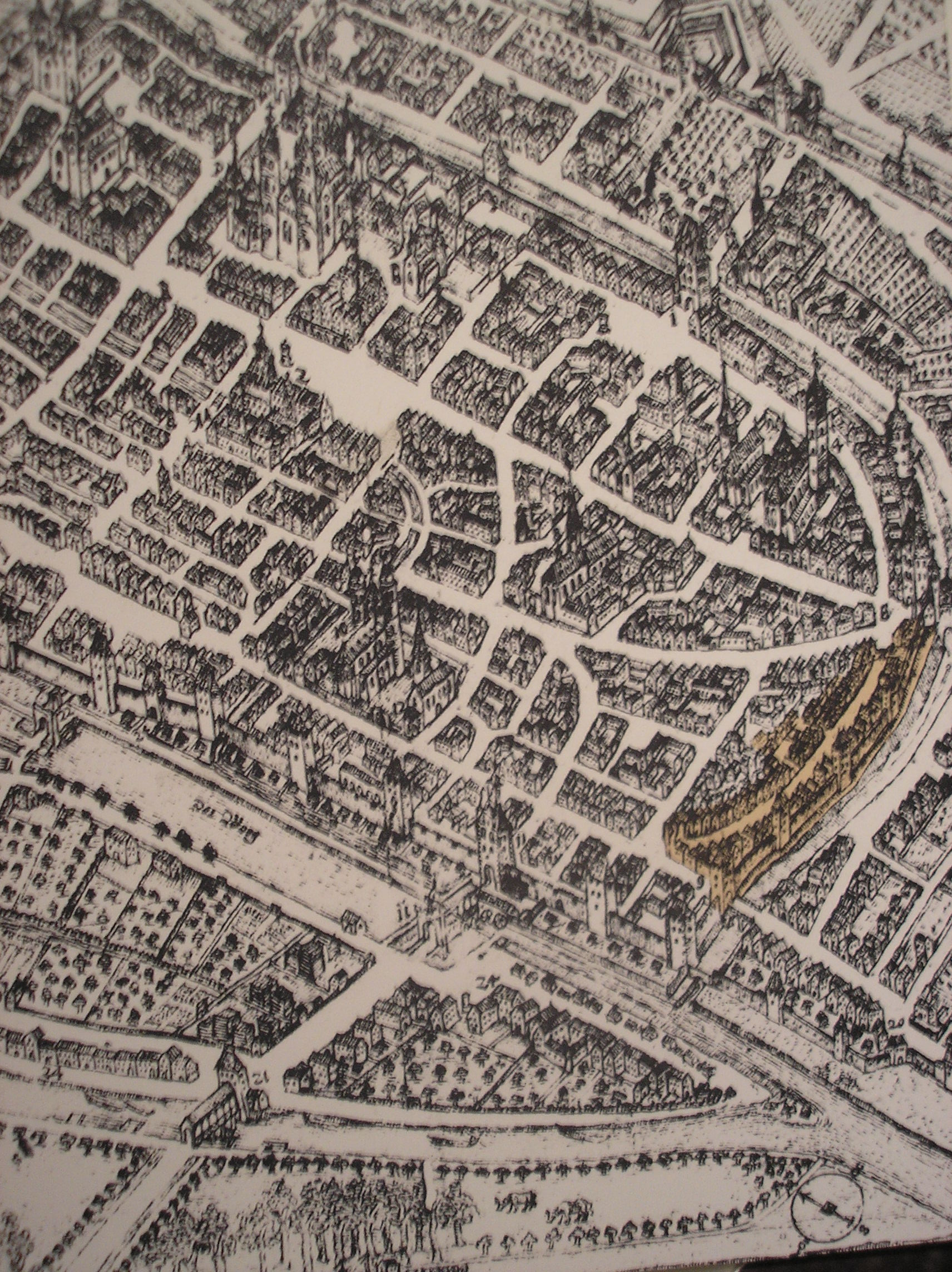


Map of Worms in 1630. The Jewish Ghetto is marked in yellow.

The city is known as a former center for Judaism. The Jewish community was established in the late 10th century, the first synagogue was erected in 1034. The Jewish Cemetery in Worms, dating from the 11th century, is believed to be the oldest in Europe. The Rashi Shul, a synagogue dating from 1175 and carefully reconstructed after its desecration on Kristallnacht is the oldest in Germany. Prominent rabbis of Worms include Shlomo Yitzhaki (Rashi), Elazar Rokeach and Yair Bacharach. At the Rabbinical Synod held at Worms in the eleventh century, rabbis for the first time explicitly prohibited polygamy. Much of the Jewish Quarter was destroyed in the events known as Kristallnacht in 1938. Worms today has a very small Jewish community and a recognizable Jewish community in Worms no longer exists. However, after renovations in the 1970s and 1980s, many of the buildings of the Quarter can be seen in a close to original state, preserved as an outdoor museum.

THE DIET OF WORMS

The Diet of Worms: Reichstag zu Worms, was a general assembly of the Imperial Estates of the Holy Roman Empire that took place in 1521 at Worms, a small town on the Rhine River located in what is now Germany. It was conducted from 28 January to 25 May 1521, with Emperor Charles V presiding. Although other issues were dealt with at the Diet of Worms, it is most memorable for the Edict of Worms (Wormser Edikt), which addressed Martin Luther and the effects of the Protestant Reformation. The previous year, Pope Leo X had issued the Papal bull Exsurge Domine, outlining forty-one purported errors found in Martin Luther's 95 theses and other writings related to or written by him. Luther was summoned by the emperor. Prince Frederick III, Elector of Saxony obtained an agreement that if Luther appeared he would be promised safe passage to and from the meeting. Such a guarantee was essential after the treatment of Jan Hus, who was tried and executed at the Council of Constance in 1415 despite a safe conduct pass. Emperor Charles V commenced the Imperial Diet of Worms on 28 January 1521. Luther was summoned to renounce or reaffirm his views. When he appeared before the assembly on 16 April, Johann Eck, an assistant of the Archbishop of Trier, acted as spokesman for the emperor.


BACHARACH

Bacharach, named for Bacchus, the ancient Roman god of wine, is a medieval walled town only meters from the river's banks. The Rhine river once splashed up against the town's walls, but a landfill has been added to accommodate a road, train tracks and boat docks. From 1300 to 1600 Bacharach was a major wine center. Due to shallow waters, ships had to unload upstream and reload in Bacharach, so every boat traveling the Rhine had to stop here. At it's peak Bacharach boasted a population of 6,000, though today it is closer to 1,000. The view of town from the Rhine belies the charm hiding within. The town is a collection of some of the finest half-timbered medieval houses in Germany, some dating back to the 14th century.


Top Sights in Bacharach

Just one visit to the town square is enough to make you fall in love with this jewel of a town. You'll be transported into Medieval Germany as you walk the cobbled streets and admire the quaint half-timbered facades. Life seems to have slowed down here, and you can too among the small shops and Weinstubes. A wine room is an establishment that serves wine and some food. Often the food will be a sampling of cheeses and breads to compliment the wines offered. A bit further away from the church and on the same side of the Ober Strasse you will find the TI and Post office, or Posthof. Recognize it by the golden horn shaped sign that hangs above the entrance. (These horns have long symbolized the postal service in Germany.) WWII buffs will want to enter the courtyard of the post office to see an eerie reminder of years past - a fascist eagle from 1936 over the door on your left. Steep steps along the side of the church lead up to the town's castle. Now a youth hostel it is probably not worth the hike if you aren't staying there. However, you should follow the steps until you reach Werner Kapelle, a skeleton of an old chapel with no windows, doors or ceiling. It's a beautiful sight when lit up at night. It was a regular stop on the Grand Tour in the 1800's as a place to contemplate the impermanence of human endeavor. The Altes Haus, or old house, is also located just off the square. This red and white building dating back to 1368 is the oldest still standing in Bacharach. As with many older buildings, you will find its date on the facade near the top of the ground floor. Today the Altes Haus houses a Weinstube.From the town square, if you pass the Altes Haus, you will come to Fritz Bastian's Wine Tasting, on your left. This Weinstube, which also has an outdoor garden, is a fine place to sample the wines of the region. For a set price, you get a sampling of about 15 different white wines from the Rhine Region.Across the street you will find the Münze, or old mint. As with many professions in Germany, the sign tells the story. This one is adorned with the image of an old coin.From here look up the hill to see one of the town's original towers. For an excellent view, hike up to it by continuing past the Münze and making a left on Rosen Strasse. About 100 paces from here you will reach an old well. Behind the well is a tiny stepped path that leads through the vineyard and up to the tower. If the tower is open you can go to the top of the town wall for a wonderful view overlooking the town and six of its remaining nine towers. You can also walk along the top of the town's walls on the sections nearest to the train tracks. While some parts are not very attractive and seem abandoned, you'll get a feel of Medieval Bacharach.


Day 9 (May 18th) Castle Eltz & the Rhine River


AGENDA:
1. Breafest
2. In the morning Rhine River Curse
3. Lunch at St. Goar
4. Visit Rheinfels Castle

5. Tour Eltz Castle
6. Take train back to Bacharach for the night


RHINE RIVER CURSE

The Rhine is one of the longest and most important rivers in Europe, at 1,320 km (820 mi), with an average discharge of more than 2,000 m3/s (71,000 cu ft/s). The name of the Rhine derives from Gaulish Renos, and ultimately from the Proto-Indo-Eruopean root *reie- ("to move, flow, run"), which is also the root of words like river and run. The Rhine and the Danube formed most of the northern inland frontier of the Roman Empire and, since those days, the Rhine has been a vital, navigable waterway, and carried trade and goods deep inland. It has also served as a defensive feature and has been the basis for regional and international borders. The many castles and prehistoric fortifications along the Rhine testify to its importance as a waterway. River traffic could be stopped at these locations, usually for the purpose of collecting tolls, by the state that controlled that portion of the river.

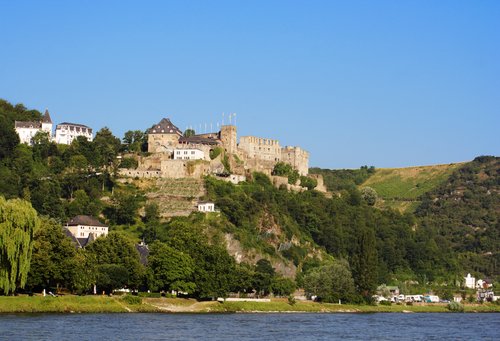
We will cruse the best and most scientci part of the rhine river (a thirty mile streach from Bacharach north to St. Goar).


RHEINFELS CASTLE

Burg Rheinfels is a castle ruin located in Sankt Goar, overlooking the Rhine river. It was started in 1245 by Count Diether V of Katzenelnbogen and was partially destroyed by French Revolutionary Army troops in 1797. It is the largest castle overlooking the Rhine, and historically covered five times its current area.

BURG ELTZ

Lurking in a mysterious forest, it's been left intact for 700 years and is furnished throughout much as it was 500 years ago. Thanks to smart diplomacy and clever marriages, Burg Eltz was never destroyed. It's been in the Eltz family for 850 years. Elz is the name of a stream that runs past the castle through a deep valley before emptying into the Mosel. The first record of a Burg (castle) on the Elz is from 1157, built to protect a trade route. By 1472 the castle looked like it does today: the homes of three big landlord families gathered around a tiny courtyard within one formidable fortification. Today, the excellent 45-minute tours wind you through two of those homes while the third remains the fortified quarters of the Eltz family. The elderly countess of Eltz — whose family goes back 33 generations here (you'll see a photo of her family) — enjoys flowers. Each week for 40 years she's had grand arrangements adorn the public castle rooms. It was a comfortable castle for its day: 80 rooms made cozy by 40 fireplaces and wall-hanging tapestries. Many of its 20 toilets were automatically flushed by a rain drain. The delightful chapel is on a lower floor. Even though "no one should live above God," this chapel's placement was acceptable because it filled a bay window, which flooded the delicate Gothic space with light. The three families met — working out common problems as if sharing a condo — in the large "conference room." A carved jester and a rose look down on the big table, reminding those who gathered that they were free to discuss anything ("fool's freedom" — jesters could say anything to the king), but nothing discussed could leave the room (the "rose of silence").


Day 10 (May 19th) Rothenburg & Nurnberg


ROTHENBURG

The best preserved medieval town in Germany, Rothenburg ob der Tauber fits the word romantic perfectly. Walk the wall that encircles Rothenburg to get various perspectives of architecture in the middle ages (as well as a lot of exercise). Climb to the top of the Rothenburg Town Hall Tower (circa 1250-1400) for the wide angle view of Rothenburg and surrounding, mostly pastoral countryside. To feel the excitement of a medieval traveler as he approached this then important town, view Rothenburg's incomparable silhouettes from the plateau across the Tauber River Valley (in the direction of the village of Schwarzenbronn) and from the ancient double vaulted bridge on the valley floor. The whole walled town of Rothenburg is a museum. The wall connects five medieval gates complete with guard towers that date from the thirteenth to sixteenth centuries. Just walk along Rothenburg's narrow cobblestone streets and admire the gothic, renaissance, and baroque houses and fountains. You may wish that you had lived in these prettier, quieter, slow times. A visit to the Rothenburg Crime Museum, with its extensive display of instruments of torture and execution should bring you back to reality. Besides itself, Rothenburg offers a complete card of good medieval concerts, festivals, plays from the middle ages, guided walks, historic hotels and restaurants, gothic churches, art exhibits, museums, suits of armor, and great Franken wine, to name only a few.

SITES OF ROTHENBURG

JACOBS CHURCH

Built During The height Of Rothenburg's Gothic Period, The Jacobs Church Took Over 170 Years To Complete (1311-1484). The Church's Greatest Artistic Treasure Is The Holy Blood Alter Carved By Tilmann Riemenschneider Between 1499 and 1505. The Alter Gets Its Name From The Rock Crystal Capsule Mounted In The Gold Cross Set In The Alter. Since The Middle Ages, The Capsule Is Said To Contain Three Drops Of Christ's Blood. If You Like Organ Music, Recitals Are Offered Twice A Week During The Summer. Open: 9:00 AM-5:30 PM (Easter To October), 10:00-12:00 And 2:00-4:00 PM (November To Easter).

THE EARLIEST TOWERS
The Markus and White Towers (circa 1172) are the gates to the original twelfth century Rothenburg. Next to the White Tower, you will find the medieval Jewish Dance Hall. The small adjacent garden has ancient Jewish gravestones built into the stone wall.

MEDIEVAL CRIME MUSEUM
The Rothenburg medieval Crime Museum features the best collection in Europe of antique objects and documents pertaining to crime and punishment from the twelfth to the nineteenth centuries. It presents, often graphiclly four floors and 2000 square meters of medieval laws, verdicts, punishment and torture devices used to keep the little people in line.

ROTHENBURG VAULTS
The museum nicely presents costumes, weapons, and scenes of the Thirty Years War between Protestants and Catholics (1618-1648). Explanations are in German and English. Don't miss the dungeon. Heinrich Toppler, Rothenburg's greatest mayor died in the dungeon in 1408.

NURNBERG


THE MAIN SITES OF NURNBERG

The Altes Rathaus, (old city hall) next to the hauptmarket in central nuremberg was once the site of speeches by nazi party big wigs during the nurnberg party rallies. Today a visitor can take a tour of it's 14 th century dungeons.

The Ehrenhalle was built in 1929 as a military monument. During the 1930's nazi party rallies it was part of the luitpold arena were hitler addressed S.A. and S.S. storm troopers. The ehrenhalle was surrounded by stone bleachers that could accommodate 150,000. Today most of these bleachers are covered with earth and the area is now used as a public park.

The Kongresshalle, (nazi party congress hall) was designed by franz and ludwig ruff. Construction of this massive building began in 1938 but was never completed because of the out break of WWII. The design of the building was inspired by the coliseum in rome. Built to accommodate 50,000 people it was to be used for nazi party meetings. today it is used as a warehouse and is home to the dokumnetationszentrum, (documentation center), an excellent museum about the third reich and the holocaust.

The Zeppelintribune grand stand was built in 1933 for the first nazi party national rallies. These rallies where held in september in 1933 through 1938. The rallies were discontinued on the out break of WWII. during the years of the third reich the zeppelintribune underwent several changes. These additions and up grades were supervised by albert speer. On the top of the large buliding in the center of the grand stand was a huge swastika. It was blown up by american troops in 1945. Also, there was a row of columns on the top of the grand stand. they were removed in 1967.

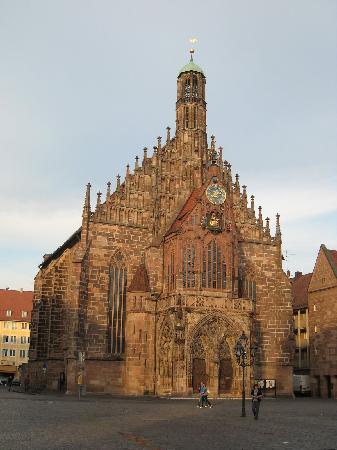
The Frauenkirche, ( church of our lady) was built in the 14 th century. At noon each day mechanical figures act out the story of the golden bull of 1356. Inside the church is the 1440 tucher alter. This church is located on the hauptmarkt in the center of old nuremberg. During the years of the third reich the hauptmarkt was called adolf hitler platz. It was here that hitler reviewed his political organizations during the nuremberg party rallies.

The Handwerkerhof ( = court of the craftsmen) 17 lovely half-timbered houses with great shops for souvenirs, Christmas-decorations from Erzgebirge, dolls made by artists etc. It is not an ordinary shopping-mall, but made with a special atmosphere and goods you may not find easily at other places. I have seen that small village, that is totally surrounded by the old medieval towers and walls, several times and it really looks great at any time of the year. The tower in the back is also called "Dicker Turm" (fat tower) This place is also fine for a snack or meal in one of the restaurants. Nürnberger Rostbratwürste are a Must !!

The Palace of Justice, home of the 1946 nuremberg trials of nazi war criminals. located in furth on the the outskirts of nurnberg it was the only undamaged building in the nuremberg area that was large enough to hold the trial. in the main trial in 1946 the following defendents were tried, martin borman, (in absentia), karl donitz, hans frank, wilhelm frick, hans fritzsche, walter funk. hermann goring (commited suicide during the trial), rudolf hess, alfred jodl, ernst kaltenbrunner, wilhelm keital. robert ley, (committed suicide during the trial), konstantin van neurath, franz von papen, erich raeder, joachim von ribbentrop, alfred rosenberg, fritz sauckel, balder von schirach, hjalmar schacht, arthur seyss-inquart, albert speer, and julius streicher. after the main trial there were several other trials of lesser known nazis. the palace of justice is open to the public on weekends.

Mauthalle is one of the biggest medieval buildings in the centre of Nürnberg / Nuremberg and you may quickly understand how easily clever people could make money by getting toll from the merchants passing by on the road or on the river. In 1498 the building was first constructed as a storing-place for salt and wheat and later it became the toll-hall and a place to officially weigh all of the goods. Today this building is a shopping-centre with a great beer-hall and restaurant in the cellar - see my restaurant tip about "Barfüsser"

Day 11 (May 20th) Nurnberg & Wittenberg


WITTENBERG

Wittenberg is home to numerous important historical artifacts, as well as portraits and other paintings by the Cranachs. On the doors of All Saints' Church, the Schlosskirche ("castle church" built 1496–1506) Luther nailed his 95 theses in 1517. It was seriously damaged by fire in 1760 during a bombardment by the French during the Seven Years' War, was practically rebuilt, and was later (1885–1892) restored. The wooden doors, burnt in 1760, were replaced in 1858 by bronze doors, bearing the Latin text of the theses. Inside the church are the tombs of Luther and Philipp Melanchthon, and of the electors Frederick the Wise (by Peter Vischer the Younger, 1527) and John the Constant (by Hans Vischer), and portraits of the reformers. St. Mary's Church, the parish church in which Luther often preached, was built in the 14th century, but has been much altered since Luther's time. It contains a magnificent painting by Lucas Cranach the Elder, representing the Last Supper (with the faces of Luther and other reformers), Baptism and Confession, also a font by Hermann Vischer the Elder (1457). In addition, there are numerous historic paintings in the church. The ancient electoral palace is another of the buildings that suffered severely in 1760; it now contains archives. There are also Melanchthon's house and the house of Lucas Cranach the Elder (1472–1553), who was mayor of Wittenberg. Statues of Luther (by Schadow), Melanchthon and Bugenhagen embellish the town. The spot outside the Elster Gate where Luther publicly burned the papal bull in 1520 is marked by an oak tree.


SITES IN WITTENBERG

AUGUSTINIAN MONASTERY
Part of the Augustinian monastery in which Luther dwelt, at first as a monk and in later life as owner with his wife and family, is preserved, and is now the world's premier Luther museum. It contains numerous priceless historical artifacts, and portraits and other paintings by the Cranachs.

LUTHER MEMRIAL


MELANCHTON-HOUSE

This is the house where Philipp Melanchthon lived


ALL SAINTS CHURCH
All Saints' Church, the Schlosskirche ("castle church"), to the doors of which Luther is said to have nailed his famous 95 theses in 1517, dates from 1439-1499. It was seriously damaged by fire in 1760 during a bombardment by the French during the Seven Year's War, was practically rebuilt, and was later (1885-1892) restored. The wooden doors, burnt in 1760, were replaced in 1858 by bronze doors, bearing the Latin text of the theses. Inside the church are the tombs of Luther and Philipp Melanchthon, and of the electors Frederick the Wise (by Peter Vischer the Elder, 1527) and John the Constant (by Hans Vischer), and portraits of the reformers by Lucas Cranach the younger.

ST. MARY'S CHURCH
St. Mary's Church, the parish church in which Luther often preached, was built in the 14th century, but has been much altered since Luther's time. It contains a magnificent painting by Lucas Cranach the elder, representing the Lord's Supper (with the faces of Luther and other reformers), Baptism and Confession, also a font by Hermann Vischer (1457). In addition, there are numerous historic paintings in the church.

Day 12 (May 21) Berlin


BERLIN

BRANDENBURG GATE

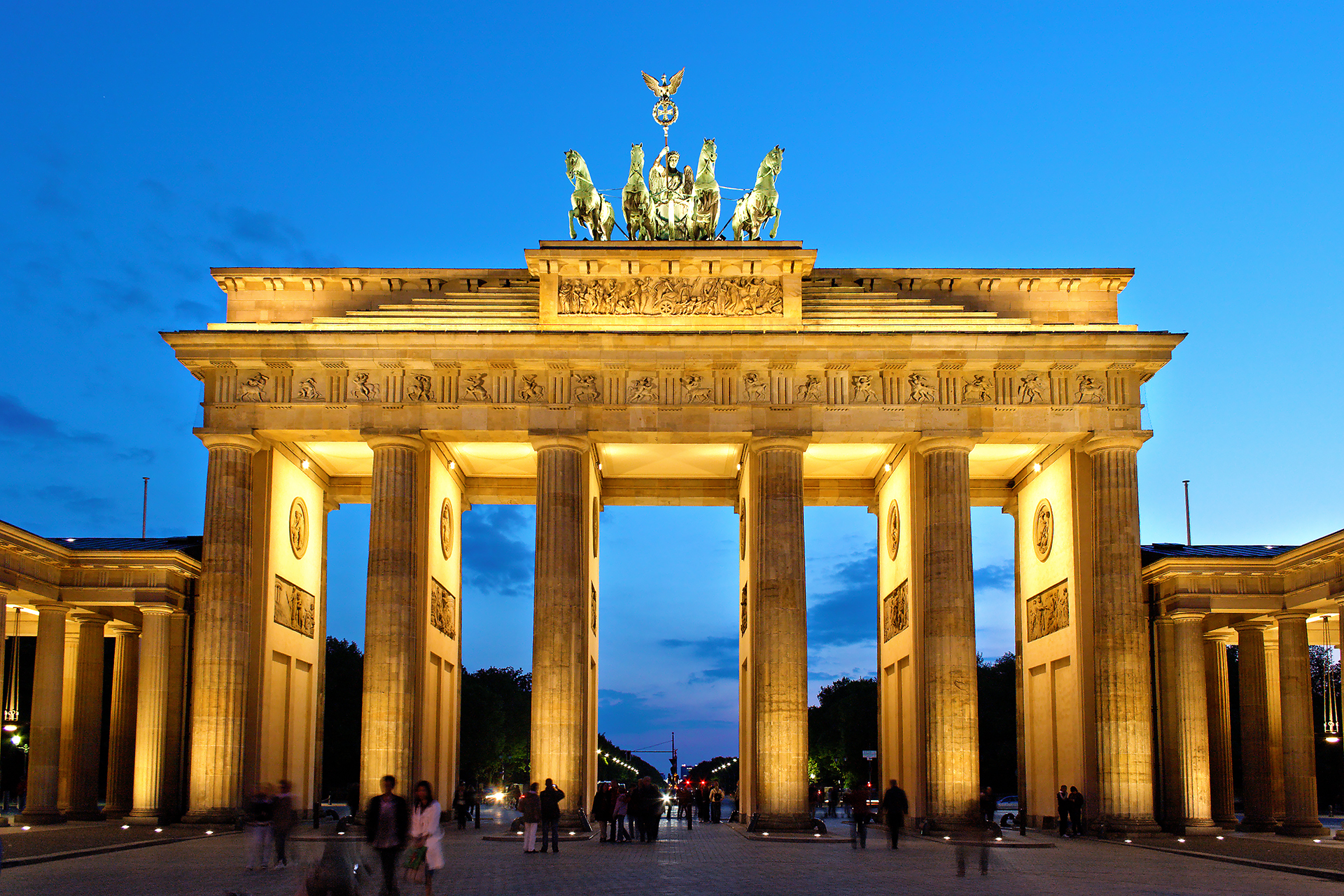
The Brandenburg Gate is an iconic landmark of Berlin and Germany. It also appears on German euro coins (10 cent, 20 cent, and 50 cent). The Reichstag building is the traditional seat of the German Parliament, renovated in the 1950s after severe World War II damage. The building was again remodeled by British architect Norman Foster in the 1990s and features a glass dome over the session area, which allows free public access to the parliamentary proceedings and magnificent views of the city.


THE PERGAMON MUSEUM

The Pergamon Museum is one of the largest and most impressive museums in Berlin, and if you only get to see one museum, this should be it. Itwas named after an ancient Greek city and was eventually opened in 1930 after a long period of construction. Building had started in 1907 but was severely interrupted due to World War I and the subsequent years of economic hardship in Germany. Like so many other notable Berlin museums, it is located on Museum Island and is listed as a UNESCO world heritage site.

The Pergamon is divided into several areas including Near East Museum, the Islamic Art Museum, Folk Museum and the Antiquity Collection. There is also an Ancient Coin Museum. Its main focus is on ancient and early modern history.

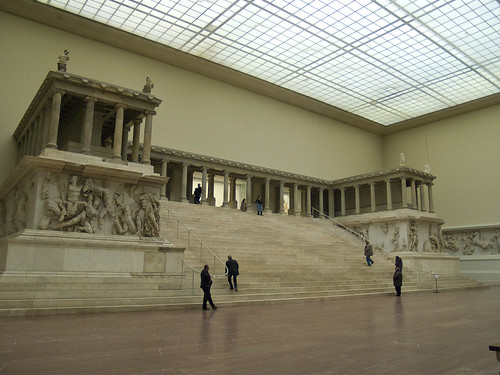
One of many striking artifacts in the Antiquity Collection is the massive structure of the Altar of Zeus. It originally came from the Acropolis of Pergamon (Turkey) where some of the base still remains. Nearly the entire 2000 year structure was uprooted and taken by the Germans to the museum. It takes up the space of a whole room and its transportation is an engineering feat. The marble staircase is spectacular. Some suggest it is one of the largest single structures to be housed in a museum.

Other large pieces include a panel from the Palace Throne Room from Babylon (Iraq), the Babylonian Procession Street, the Lions Parade panel, the Market Gate of Miletus, the Islamic Mshatta facade and the massive, mosaic Ishtar Gate with its ornately placed unicorns.

There are so many noteworthy masterpieces on display that is would take several days to thoroughly investigate all exhibits. For those with a keen interest in antiquity, a visit to this museum is a must.


THE TOPOGRAPHY OF TERROR

The Topography of Terror chronicles the horrors and atrocities of the Nazis from the period 1933 to their fall in 1945. It is situated near the boundary between West Berlin and the former communist East Berlin and is adjacent to part of the Berlin Wall which was erected during the Cold War.

It is an open air museum, built on and near the former buildings used by the Third Reich Government during their time in power. Many of these buildings, such as the Gestapo and SS Headquarters, were completely destroyed during the war and the subsequent allied invasion.

In the late 1980s, these ruins were excavated and revealed cellars which were used by the Nazis to torture, imprison and kill political prisoners. In 1987, the site was made into a memorial and museum dedicated to revealing the horrors of the German Third Reich.

KAISER-WILHELM MEMORIAL CHURCH

The most striking building on Kurfürstendamm, Berlin's most exclusive shopping street, in the half destroyed Kaiser-Wilhelm Memorial Church (Gedächtnis-Kirche). Initially, there were plans to demolish the church to make place for a new one, but due to public pressure this did not happen. Instead, the church stands were it always has, with its bombed out tower - a constant reminder of the Second World War. Today, the church is a memorial hall, where visitors can still see the ground floor interior of the church as well as see before and after shots, and learn more about the history of the church and the surrounding area. Even though the old church was never demolished, a new one was built. Standing in stark contrast just beside the original is the new church, designed and built in the 1960s.


Day 13 (May 22) Travel Home

FLIGHT TIMES
11:05 am depart Berlin
12:05 pm arrive in London
2:30 pm depart London
6:30 pm arrive in Dallis
9:30 pm depart Dallis
10:35 pm arrive in Little Rock